When agents write the code, your tools become the bottleneck

Aaydha Team
Oct 20, 2026 · 5 min read
Anthropic just published how it replaced git for its own monorepo. The interesting part is not the new version control system. It is the reason they needed one: once AI agents write most of the code, the tools around the code become the thing that slows you down.
In Redesigning source control at Anthropic, the company’s source control team explains why they built Scion, an in-house, server-centric version control system, and moved their monorepo off git in five months. Here is what happened, and what we think it means for teams that are nowhere near Anthropic’s scale.
What happened
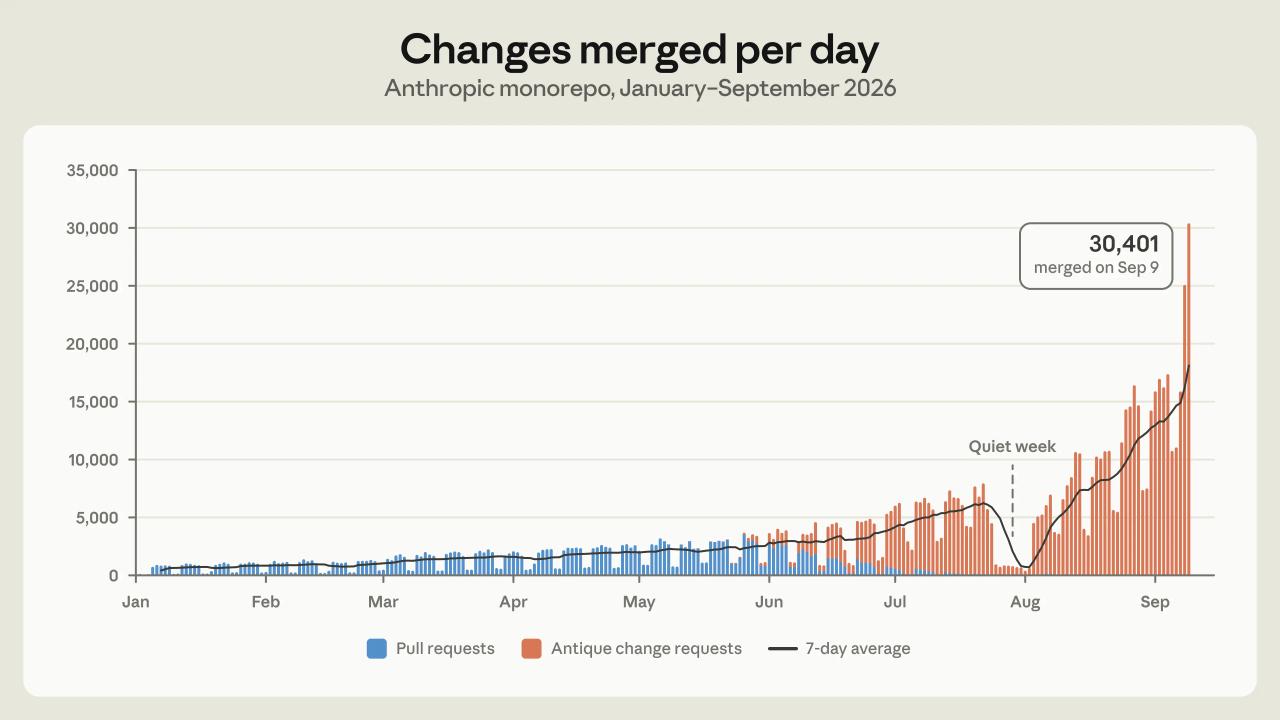
Between May and September 2026, the number of changes merged into Anthropic’s monorepo each day went from about 2,500 to more than 30,000. Most of those changes came from agents and automated jobs, not people at keyboards.
Git is built on the idea that every clone holds a full copy of the repository. That is a great design for open source and for most companies. It breaks down when the main branch history is close to 100 GB, the working copy is over 25 GB, and CI runs around 25 million checkouts a day. Anthropic estimates that fetching naively would have meant more than 600 PB of traffic a day. They were running several hundred git mirrors just to keep up.
Their conclusion: they were already using git as a centralised system, so they built one that is centralised on purpose.
The ideas behind Scion
The article sets out a handful of principles. The ones that stood out to us:
- Clients are always online. Agents and CI jobs are never on a plane, so they don’t need a full local copy. They fetch only what they touch.
- The server does the heavy lifting. History, blame, commits, merges and rebases happen server-side. The client keeps a small cache and the files it is working on.
- Source control is an API. Jobs like automated bisect or revert can ask the server questions directly, without checking anything out.
- The working copy is optional. CI can request just the diff, and checkouts are sparse or virtual by default.
Anthropic credits prior art openly: Google’s Piper and Meta’s Sapling, especially its Mononoke server, pioneered many of these techniques.
The results
According to the article, Scion uses about 200 times less CPU and memory than the git mirrors it replaced, checkouts take seconds instead of minutes, and CI alone got back 25% of its CPU capacity. Every caching tier hits more than 99% of the time.
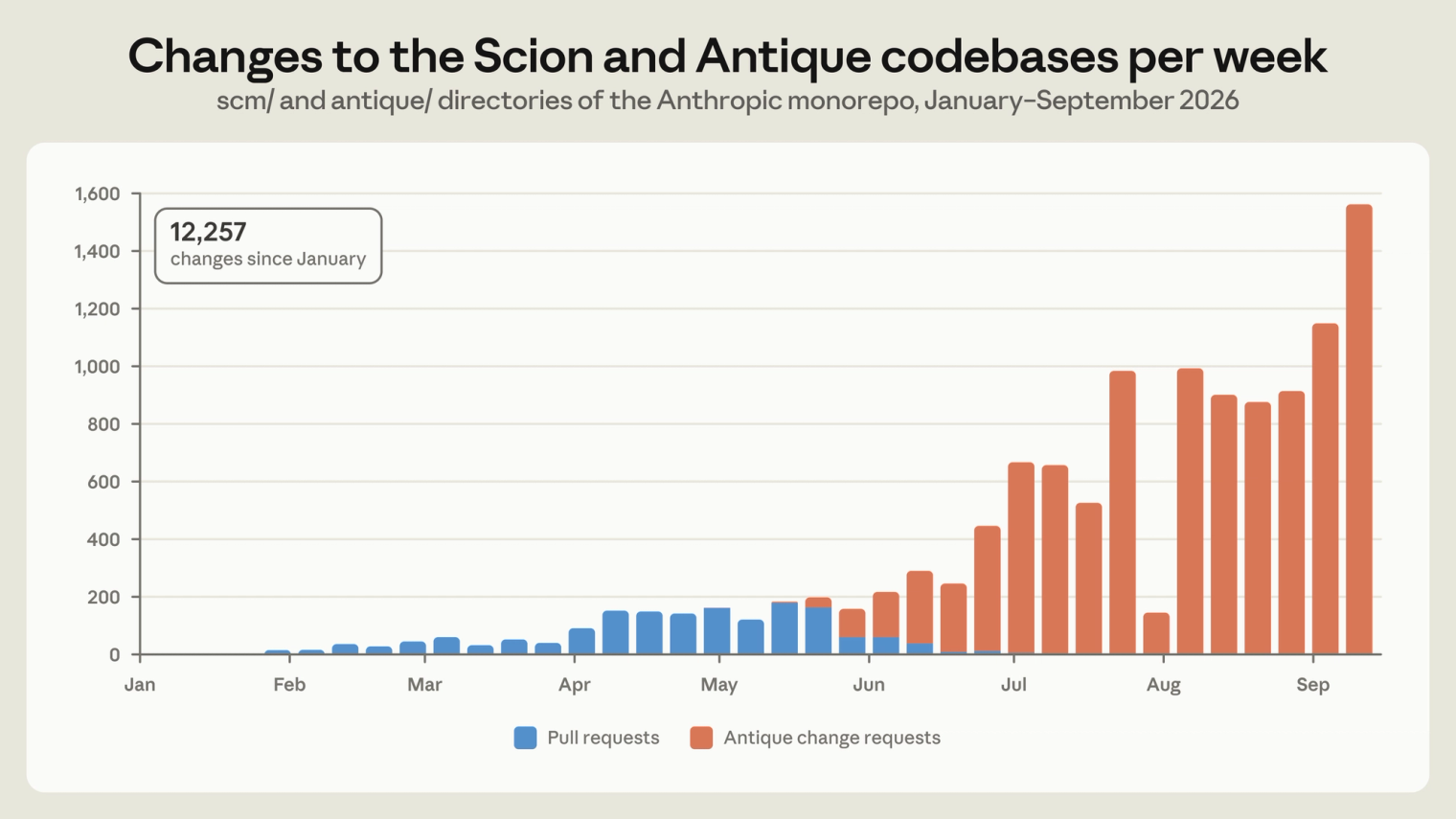
Seven people built it, along with a new code review tool, while daily merges grew tenfold.
The part worth reading twice
The most useful section is not about storage. It is about how the team worked with Claude while building Scion. Their line that stuck with us:
“Very often, we found that the role of the engineers was to tell Claude ‘no.’”
The engineers’ job shifted toward design judgment: rejecting changes that broke system constraints, cutting over-engineering aimed at problems that would never happen, and reviewing for intent rather than line-by-line syntax. They also leaned on heavy testing (hermetic simulations, fuzzing, rate limits) and on Claude instances that each watch one component’s logs for subtle problems.
They also dropped the classic merge queue with a global lock. At agent volumes it simply cannot keep up, so they test after merge and before deploy, and let Claude fix conflicts.
What this means if you are not Anthropic
Anthropic is clear that Scion is not a git replacement for everyone, and almost nobody reading this needs to build their own version control. But the pattern behind it shows up long before you hit 30,000 merges a day. In the products we build, we see the same shift on a smaller scale:
- Find the new bottleneck. When an agent can write a feature in minutes, slow CI, flaky tests, manual review queues and unclear deploy steps become the real limit. Measure those, not typing speed.
- Make your tools answer questions, not just store files. Agents work best when they can query builds, logs, tickets and history through an API instead of scraping a UI or cloning everything.
- Put judgment where it matters. Reviewing every line an agent writes does not scale. Reviewing intent, constraints and risk does. Decide up front what an agent may change on its own and what needs a person.
- Invest in tests before you invest in speed. Anthropic could move fast because the system was heavily tested. More agent output without a strong safety net just means more bugs, sooner.
Our take
The headline numbers are impressive, but the real lesson is about where engineering effort goes when code is cheap. Writing code is no longer the scarce skill. Knowing what to build, what to refuse, and how to check the result is.
That is the way we work with clients at Aaydha Tech: senior people make the calls, AI does the volume, and the tests and infrastructure keep both honest. If your team is adopting coding agents and finding that everything around the code is now the slow part, talk to us.
Source: “Redesigning source control at Anthropic”, Anthropic Engineering, October 2026. All figures quoted above are from that article. Read the original.
- AI
- Engineering
- Developer tools
- Agents

Written by the Aaydha Tech team
Designers, engineers and AI specialists who build digital products for startups and enterprises.